The Lamp That Went Out at Kondapalli

This evening, a lamp was lit on a stone pillar atop Thiruparankundram hill, outside Madurai.
Getting one flame onto this pillar has taken decades of communal perseverance, British Privy Council ruling, legal battles, a judge of the Madras High Court, a division bench, two orders of the Supreme Court, the suspension of a temple's board of trustees and the Central Reserve Police Force.
Eight hundred kilometres north, on the banks of the Krishna, there is another hill where Kondapalli Kota is situated. I was born and brought up in its shadow. Some five and a half centuries ago a lamp went out there. No court stood between those priests and the sword, and there was no court anywhere in the land where they could have been heard. Their names are not recorded in history. Their story is.
The fort that would not fall
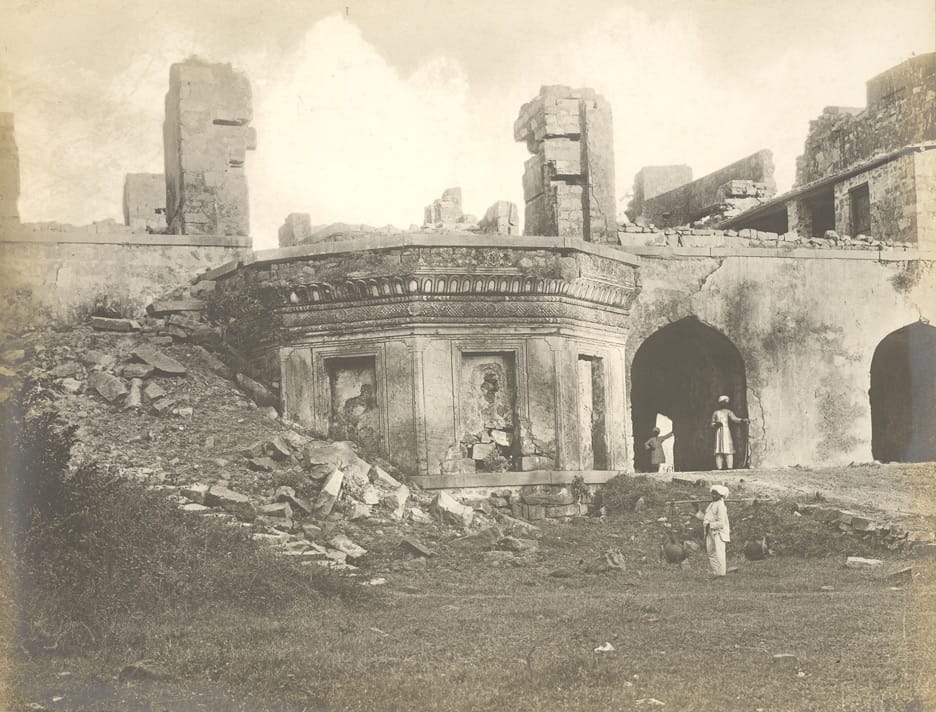
Kondapalli Kota crowns a ridge of the Eastern Coramandel Ghats above the Krishna. People in my part of the world still call it shatru durbhedyam: the fort no enemy can break.
In the 1470s, the young Sultan, Muhammad Shah III, set out to take the one hill that defied him. He paid his entire army a full year's wages in advance.
Bhima Raja, the commander of the fort, had prepared for the siege. He had filled the fort with grain and water, and from behind those walls he held off the Sultan's army for six months. A commander whose name survives only as a line in a Ferishta's Persian chronicle, holding one hill against an empire through a whole season and more. In the end he surrendered, on a promise of pardon.
The lamp goes out
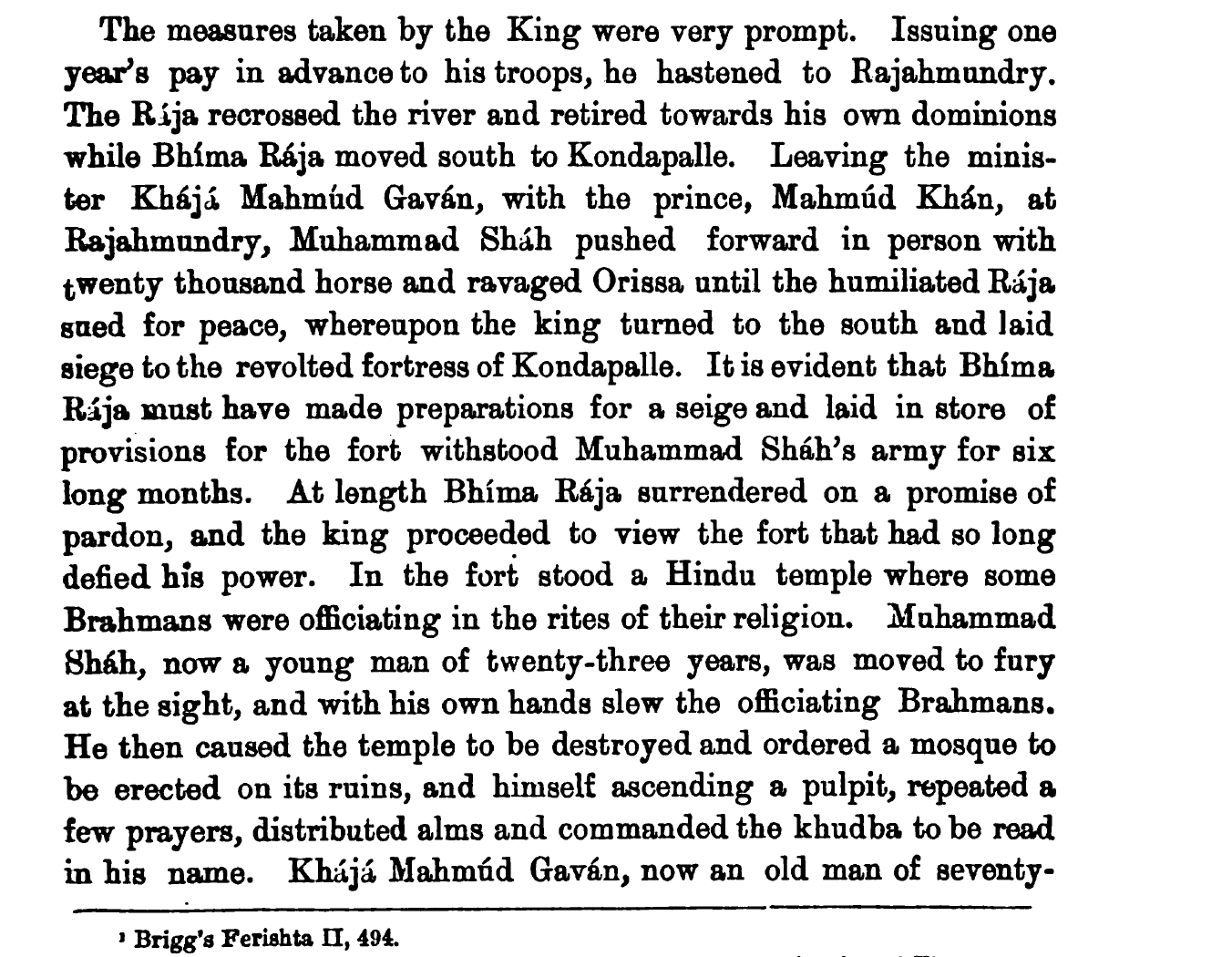
Muhammad Shah rode up to inspect the fort that had humiliated him for half a year. Inside stood a Hindu temple, and inside the temple a few Brahmins were going about their rites, as priests on that hill had done for generations: the lamp, the water, the mantra, the flowers. The Sultan was twenty-three years old. Ferishta says he was moved with fury at the sight and killed the officiating Brahmins with his own hands. Then he had the temple pulled down, ordered a mosque raised on its ruins, climbed a pulpit, said a few prayers, gave alms, and had the sermon read in his own name.
Standing near him was his prime minister, Khwaja Mahmud Gavan, a Persian merchant-scholar of about seventy-five and, by every account, the most honest man at that court. Gavan did not object. He suggested that since His Majesty had slain these infidels with his own hands, he might now fairly take the title of Ghazi, a holy warrior. Even Gordon Mackenzie, the British officer who compiled Kistna district's history in 1883, could not hide his distaste. He called it "this lamentable exhibition of youthful bigotry."
Others stood aghast and murmured that it was an inauspicious act. No king of that line had ever killed a Brahmin. The Sultan's own men knew it was wrong, and some of them said so. And then the lamp on the hill went out, and the camp moved on.
A forged letter
The Sultan stayed on the eastern frontier for three years. From Kondapalli he rode as far south as Kanchi with six thousand horsemen and plundered its famous shrine. Then he came back to Kondapalli.
Gavan was seen as a foreigner, and the Deccan-born nobles hated him for it, and for his strict, clean administration. Their leader, Nizam-ul-Mulk Bhairi, had himself been born a Brahmin in Vijayanagar. He was called Timmappa, son of Bhaira, until he was captured as a child and raised a Muslim. History has a dark sense of humour.
The plotters made friends with the Abyssinian slave who kept Gavan's seal, got him drunk, and had him stamp a blank sheet. On it they wrote a letter, as if from Gavan to the same Raja of Orissa, inviting him to invade and promising to split the kingdom between them. They told the Sultan it had been found on a captured messenger. The Sultan did not ask to see the messenger. He did not ask a single question. He sent for his minister.
Gavan's friends begged him to flee. The old man smiled and said: "My beard has grown grey in the service of his father; let it be dyed red in the service of the son." Before the king, he looked at the paper and said: "The seal is mine, but not the letter." The king rose and ordered his slave to cut him down where he stood. Gavan's last words to him were a prophecy. The death of an old man like himself, he said, was of little moment, "but to your Majesty it will be the loss of your empire and the ruin of your reputation." He knelt toward Mecca and recited his creed as the sword fell. It was the fifth of April, 1481.
Then the Sultan went looking for the traitor's fortune. The treasurer told him that three hundred rupees remained in the private purse; the rest had gone in alms. The minister had slept on a bare mat and eaten from earthen pots. His three thousand books belonged to the students of his college. Only then did someone dare to ask the obvious: who had carried the letter? No messenger could be found. There had never been one.
The man who had killed priests at their lamp had now killed the one man who might have saved him, on the strength of a forgery he never troubled to check. He left Kondapalli, which the history says had become hateful to him. His generals no longer trusted him. He drank to forget, and in March 1482, not yet thirty, he died in delirium, crying out that Gavan was tearing him to pieces. Within a generation, his dynasty doesn't matter and his empire had broken into five kingdoms.
What the sword could not kill
By about 1484, barely three years after Gavan's death, Purushottama Deva came back. The Gajapati king who had been chased home and made to buy peace marched south again and took back Rajahmundry and the Krishna frontier from a Bahmani state that was already coming apart. The empire that broke our temple could not keep our hills.
Light it again
Five centuries ago, a sultan put out a lamp on the Kondapalli hill. It's time we lit it again.
For two millennia, Amaravati, Kondapalli, Paritala and Machilipatnam were among the richest places on earth. From 1323 the Sultans came, and the clearest moment of what that meant happened on Kondapalli hill. On that same hill, the sultan who killed its Brahmin priests would later execute his wisest minister. A year later he was dead and his empire was breaking apart. The region's wealth rose once more and then drained away.
The fort still stands, neglected, much of the fort is still ruin and scrub. No one knows where the temple of the 1470s stood. In the village below, Rajasthani families still carve the light-wood Kondapalli toys that are sold across India. Amaravati, the new capital, is about few kilometres away. So here is my request, to the Government of Andhra Pradesh, to the district administration, to the departments of tourism, archaeology and forests:
Light Kondapalli again, so that the whole Krishna valley can look up and see the hill glowing. Restore the fort as a forest-resort-fort, and tell its full story honestly on its walls: the Reddy builders, Gajapatis, Bhima Raja's six months, the priests at their lamp, Gavan and his forged letter and fall of Bahmani Dynasty, Purushottama's return, Krishnaraya Sabha, Ibrahim's gardens.
All we need is to decide to light the Kondapalli glory again.